

Does your sleeping position affect night time acid reflux?
Yes, your sleeping position can affect night time acid reflux....
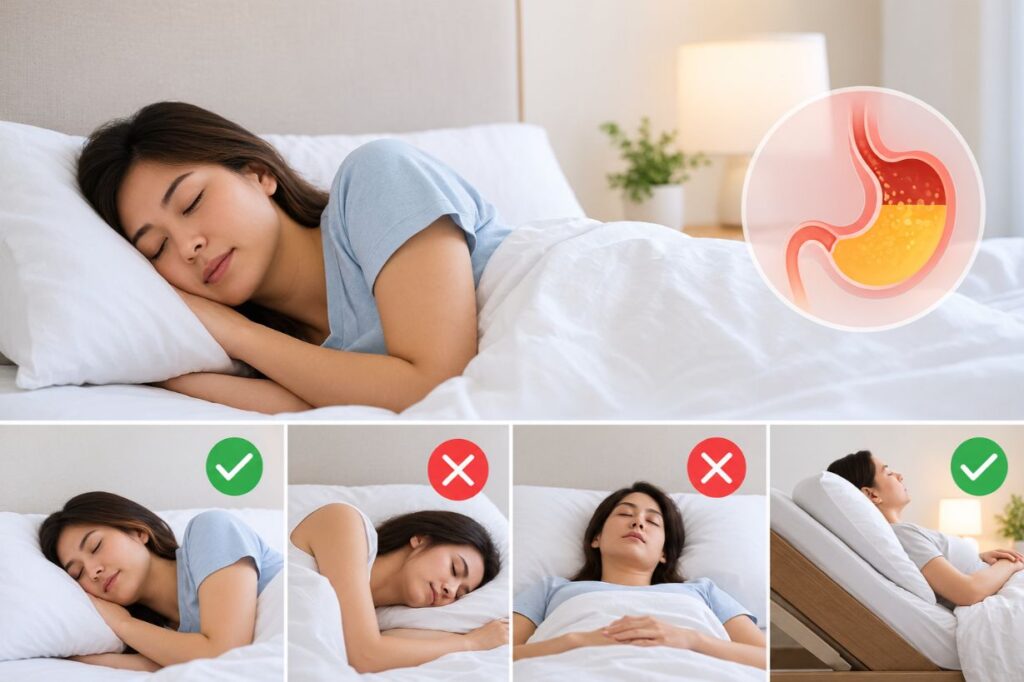
Yes, your sleeping position can affect night time acid reflux. Lying flat lets stomach acid flow back into the food pipe more easily, and sleeping on your right side tends to make reflux worse. Sleeping on your left side, with the head end of your bed raised, usually means fewer and shorter reflux episodes. Position helps, but it does not replace a proper assessment if your symptoms keep coming back.
Reflux tends to worsen at night because lying down removes the help of gravity. When you are upright, acid that escapes the stomach drains back down quickly. When you are flat, it can sit in the oesophagus (the food pipe) for longer.
Sleep also changes how your body protects itself. You swallow less often and make less saliva, and saliva normally helps to wash acid away and neutralise it. That is why a single reflux episode at 2am can feel stronger and last longer than one after lunch.
At the bottom of the oesophagus is a ring of muscle called the lower oesophageal sphincter, which acts like a one-way valve. If it relaxes at the wrong time or is weak, acid slips upward. You can read more about what weakens this valve in our page on the symptoms and causes of GERD.
For most people, sleeping on the left side is the most helpful position for reflux. Several sleep studies using acid monitoring have found fewer reflux episodes and faster acid clearance in the left side position compared with the right side or lying on the back.
The reason is anatomy. Your stomach sits mainly on the left side of your body. When you lie on your left, the junction between the stomach and oesophagus sits higher than the pool of stomach contents, so acid has to travel “uphill” to escape. Lie on your right, and that junction sits lower, making it easier for acid to leak through.
Sleeping position | Likely effect on reflux | Why |
|---|---|---|
Left side | Usually the fewest symptoms | Stomach contents sit below the valve; acid clears faster |
Back (flat) | Often more symptoms | No gravity advantage; acid can pool in the food pipe |
Right side | Often the most symptoms | Valve sits lower than stomach contents; the valve may relax more |
Stomach (face down) | Can worsen symptoms for some | Pressure on the abdomen can push stomach contents upward |
Upper body raised on an incline | Usually helpful, in any side position | Gravity keeps acid in the stomach |
Your own pattern may differ, so it helps to note which positions wake you with heartburn or a sour taste. If you share a bed, sleeping on the left may mean swapping sides.
Raising your upper body helps, but piling up pillows is usually not the way to do it. Extra pillows lift only your head and neck, which bends you at the waist and can squeeze the stomach, sometimes making reflux worse.
A better approach is to raise the whole upper body on a gentle slope. Common options include:
Give yourself a few nights to get used to the incline. If you have back, neck or hip problems, check with your doctor before changing your sleep setup.
Timing of meals matters as much as position. Try to finish your last meal two to three hours before lying down, so your stomach has emptied some of its contents before bed.
This can be hard in Singapore, where late dinners, supper with friends and late work hours are common. A few practical adjustments help:
Food triggers vary from person to person. Our guide on which foods may help with GERD can help you plan lighter evening meals.
Yes. Night reflux does not always feel like heartburn. Some people notice a dry cough, a hoarse voice in the morning, a sore throat, a sour or bitter taste on waking, or waking up coughing or choking.
A persistent cough is a common example, and our article on how acid reflux can cause a cough explains why. Chest discomfort can also occur. Because chest pain has many causes, including heart problems, read about whether chest pain is caused by acid reflux, and call 995 if you have sudden, crushing or spreading chest pain, especially with breathlessness or sweating.
See a doctor if you have reflux symptoms more than twice a week, if they regularly wake you at night, or if changing your sleep position and meal times has not helped after a few weeks. Your GP or a polyclinic is a good first step, and they can refer you on if needed.
Seek medical advice sooner if you notice any of these:
These signs do not always mean something serious, but they should be checked. Our page on acid reflux warning signs you should not ignore covers them in more detail.
Long-term, poorly controlled reflux can inflame and change the lining of the oesophagus with a risk of cancer developing in the damaged tissue, so persistent symptoms are worth assessing. At KYM Surgery’s acid reflux clinic, assessment may include an endoscopy (a thin camera passed down the throat) to look at the oesophagus and stomach. Depending on the findings, options range from lifestyle changes and medication to, for selected patients, anti-reflux surgery such as fundoplication.
Right side sleeping is linked with more reflux episodes in many people, because it places the valve at the top of the stomach lower than the stomach contents. It is not harmful as such, but if you wake with heartburn, trying your left side is a simple change to test.
A gap of two to three hours between your last meal and bedtime is commonly advised. This gives the stomach time to empty part of its contents, so there is less to reflux when you lie down.
Usually, yes. A wedge raises your whole upper body on a slope, while stacked pillows mainly bend your neck and waist. Bending at the waist can press on the stomach and may make reflux worse.
Yes. Some people have “silent” night reflux with no burning feeling. Instead, they notice a morning cough, hoarse voice, sore throat or sour taste. These symptoms are worth mentioning to your doctor.
Heartburn is common in pregnancy, and many women find left side sleeping with the upper body slightly raised comfortable. Check with your obstetrician or GP before making changes, and before taking any reflux medication while pregnant.
Doctor’s Perspective: Think of your digestive system like a one-way street that works best when gravity is on your side. The simplest change most people can make is finishing dinner earlier and staying upright for a few hours afterward. This basic timing adjustment often makes a noticeable difference.
This article is for general information only and is not a substitute for medical advice. Please consult a qualified doctor for advice specific to your situation.
Yes, your sleeping position can affect night time acid reflux....
The connection between acid reflux and teeth is often overlooked,...

Your body doesn't process food the same way at 9...
Here at KYM Surgery, we believe in providing holistic & comprehensive medical care for all patients.
Here at KYM Surgery, we believe in providing holistic & comprehensive medical care for all patients.